The Synergy of Solar and Storage: Key Considerations for a Future-Proof System
Tech & Innovations
2026 / 10 / 20 ⋅ 5 min read



Solar generation and electricity demand rarely follow the same curve. A PV array typically generates most of its output around midday, while many commercial sites also need significant power in the morning or late afternoon. Storage can help shift some of that energy to when it is needed. As battery costs and project economics continue to evolve, solar-plus-storage has become an important design option for commercial, industrial, and utility-scale projects.
Most solar-plus-storage systems involve three key design considerations: how much storage to install, which battery technology and operating limits suit the project, and how the PV array, battery, and grid will be connected through the inverter system. The optimal design depends on several project-specific factors, the site’s load profile, energy prices, grid requirements, and intended use of storage.
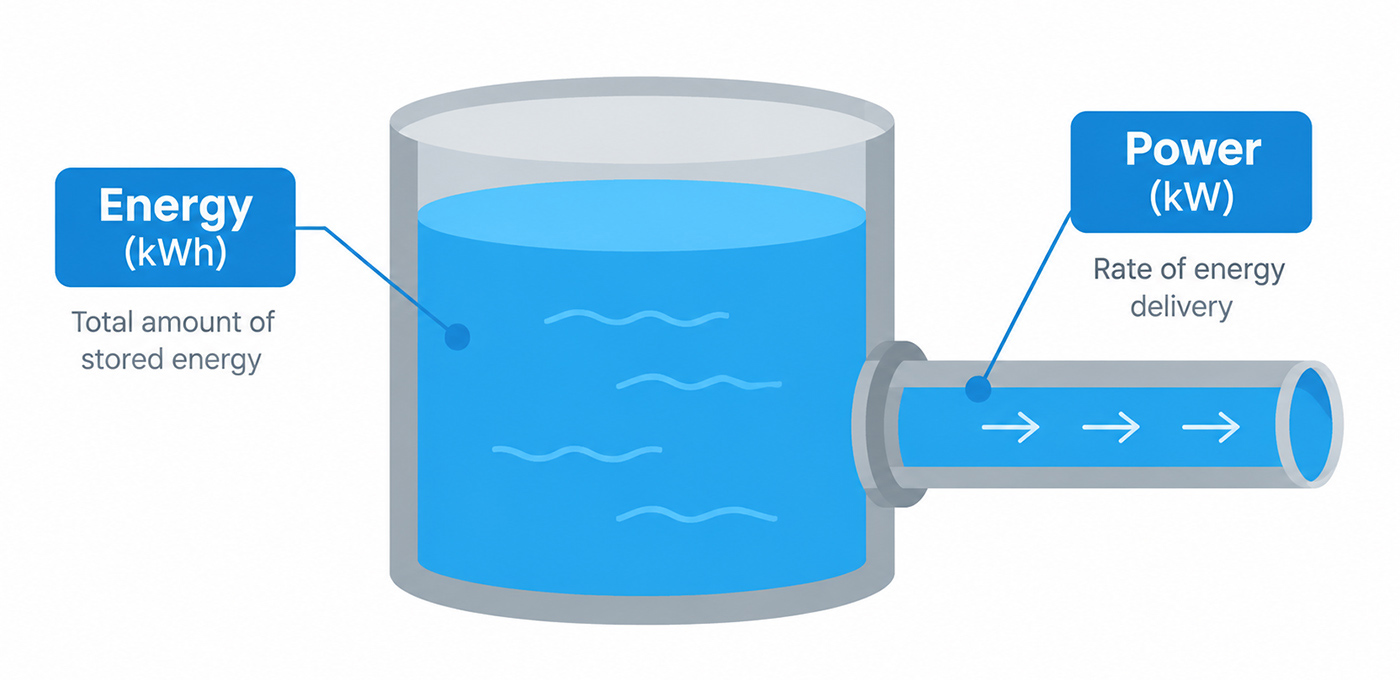
Two parameters are particularly important: energy capacity, measured in kilowatt-hours (kWh), describes how much energy the battery can store. Power, measured in kilowatts (kW), determines how quickly it can charge or discharge that energy.
Think of a water tank: the tank’s size represents energy capacity, while the flow rate through its outlet is like power. The C-rate describes the charging or discharging power relative to the battery’s energy capacity. The appropriate operating range depends on the battery design and project requirements. Both energy capacity and power must be appropriately matched to the intended application.
For example, a facility aiming to reduce peak electricity demand may require sufficient discharge power to cover short periods of high demand, while a project designed to shift solar energy into the evening may need sufficient energy capacity to cover the intended discharge period. The appropriate balance depends on the load profile, tariff structure, available solar generation, and operating strategy.
For systems that rely on solar energy for charging, the available PV generation is an important factor in determining how much energy can be stored. A battery can only absorb surplus solar energy when it is available, subject to the inverter’s capacity, the battery’s charging limits, system controls, and site demand. If the system can also charge from the grid, electricity tariffs and charging rules will additionally influence how much energy can be stored from that source.
Lithium iron phosphate (LFP) is widely used in commercial and industrial energy storage systems because of its cost profile, cycle-life characteristics, and thermal stability. A project also needs to consider the battery’s allowable depth of discharge, charging rate, and performance under local temperature conditions. In addition, fire protection measures and applicable certification requirements are also important considerations.
A battery’s service life is not defined by years alone. Some warranties specify both a time limit and a total energy-throughput limit; coverage may end when either limit is reached. This makes the expected cycling pattern important. For example, a battery that undergoes more frequent charge and discharge cycles may reach a throughput limit sooner than one used less intensively, depending on the warranty terms and actual operating conditions.
PV module performance can also affect the energy available for solar charging over the system’s life. If a project relies mainly on surplus solar generation, lower PV output over time may mean less energy is available to charge the battery, all else being equal. The actual effect depends on the load profile, system design, and operating strategy.
When assessing modules for a solar-plus-storage project, relevant information includes the degradation profile, temperature coefficient, and warranted end-of-period power. Astronergy provides these specifications in its product documentation.
Inverters determine how the PV array, battery, and grid are interconnected. In an AC-coupled system, the battery is connected on the AC side, often making this arrangement practical when adding storage to an existing PV system. In a DC-coupled system, the PV array and battery are connected on the DC side of the system, typically through a hybrid inverter or an appropriate power-conversion system. Depending on the design, this can reduce conversion steps and may allow some energy that would otherwise be clipped at the PV inverter to charge the battery. The best fit depends on system architecture, conversion efficiency, retrofit cost, operating strategy, and local grid rules.

Components selected and checked together early in the design process are less likely to create avoidable compatibility issues on site. Interfaces, control settings, and operating modes can be reviewed before installation rather than identified during commissioning.
Within the wider CHINT Group, the business portfolio covers PV modules, inverters, and battery energy storage systems. When products from these businesses are considered together, early technical coordination may help align design assumptions and component interfaces. However, compatibility, warranty coverage, service arrangements, and responsibility for system performance still need to be confirmed for the specific project and set out in the relevant contracts.
Effective coordination can prevent costly design changes later. It should complement—not replace—project-specific engineering, compatibility checks, and clear contractual responsibilities.
The investment case should take into account more than first-year savings. Key considerations include how much energy the battery is expected to shift over its service life, how usage affects warranty limits, the cost of future expansion, and the project’s expected return.
The three design decisions discussed above can have long-term cost implications. Undersized storage may leave potential demand-charge savings or peak-price shifting unrealized, while oversized storage can tie up capital in capacity that is rarely used. If the battery’s operating pattern does not match its warranty and design limits, it may reach those limits earlier than expected. An inverter platform with limited expansion options can also make future upgrades more expensive. The PV array, inverter, and battery operate as an integrated system, but each component has its own performance characteristics, warranty conditions, and service life. That is why the decisions that are difficult or expensive to reverse deserve careful attention at the design stage. Factors such as load profile, warranty structure, local grid requirements, and future expansion plans are at least as important as the headline specification of any individual component.
 https://astronergy.com.au/wp-content/uploads/2026/11/Industry-Insights-10-Saudi-Arabias-Solar-Market-Is-Scaling-Up-While-Building-for-Flexibility.jpg
714
1269
marketing.astro
/wp-content/uploads/2024/07/Astronergy-LOGO-black.png
marketing.astro2026-11-23 13:19:152026-11-24 08:59:02Industry Insights #10: Saudi Arabia’s Solar Market Is Scaling Up, While Building for Flexibility
 https://astronergy.com.au/wp-content/uploads/2026/11/Industry-Insights-9-Australias-Rooftop-Solar-Boom-When-More-Generation-Is-No-Longer-the-Whole-Story.jpg
660
1268
marketing.astro
/wp-content/uploads/2024/07/Astronergy-LOGO-black.png
marketing.astro2026-10-22 13:09:492026-11-24 08:59:11Industry Insights #9: Australia’s Rooftop Solar Boom: When More Generation Is No Longer the Whole Story
 https://astronergy.com.au/wp-content/uploads/2026/11/Solar-as-an-Asset-What-Makes-Your-PV-Project-Bankable.jpg
1152
2048
marketing.astro
/wp-content/uploads/2024/07/Astronergy-LOGO-black.png
marketing.astro2026-10-10 13:38:352026-11-24 08:59:33Solar as an Asset: What Makes Your PV Project “Bankable”?
Astronergy
News
Expos
Sustainability
Technology Innovation
Smart Manufacturing
Quality Control
Download Center
FAQs & Support
Solar Project Cases
After-sales Service
*By clicking subscribe, I agree to Astronergy’s Privacy Policy and Terms of Use.


 Industry Insights #9: Australia’s Rooftop Solar Boom: When More Generation...
Scroll to top