Industry Insights #10:Saudi Arabia’s Solar Market Is Scaling Up, While Building for Flexibility
Industry Trends
2026 / 11 / 19 ⋅ 4 min read


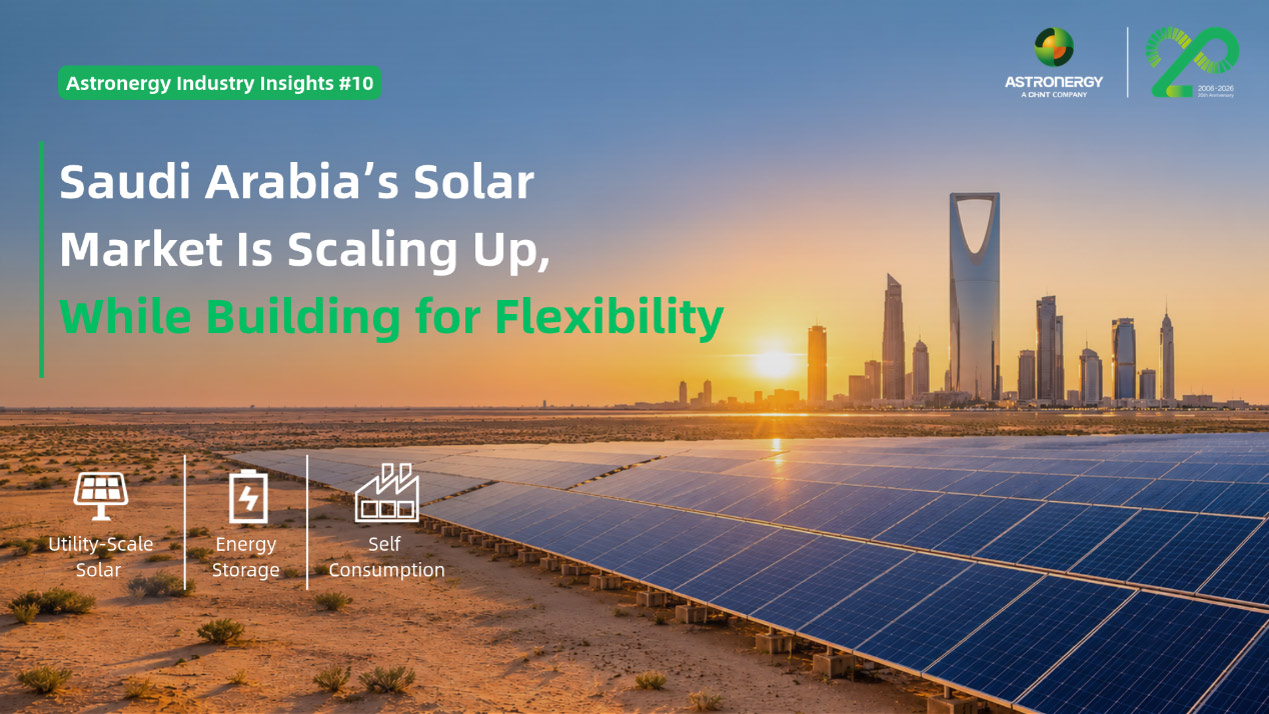
Saudi Arabia is adding solar at a remarkable pace. But as the Kingdom builds one of the world’s largest renewable energy pipelines, a new question is emerging: how can the power system make the most of this rapidly expanding solar capacity?
Supported by Vision 2030, abundant solar resources and growing electricity demand, Saudi Arabia continues to push forward with large-scale renewable energy development. Utility-scale PV remains at the center of this expansion, while battery storage and self-consumption are creating new ways to use renewable electricity.
The significance of this next phase is not that Saudi Arabia is moving away from large-scale solar. The scale of deployment itself is creating new requirements for flexibility, asset performance and more diversified applications.
Utility-scale solar will remain the backbone of Saudi Arabia’s renewable energy build-out.
According to S&P Global, more than 10 GW of utility-scale solar PV had been connected to the grid by September 2026, while the combined capacity of grid-connected projects already built or in planning had exceeded 50 GW.
In 2026, Saudi Arabia commissioned 13 renewable energy and battery storage projects with a combined capacity of 10.5 GW, including 7 GW of solar and wind capacity. Four large-scale solar projects accounted for 5.9 GW.
At this scale, the focus naturally extends beyond project development to the long-term performance of the installed capacity. Energy yield, reliability, degradation and operating performance can have a significant impact on project economics over decades of operation.
This is particularly relevant in Saudi Arabia, where high temperatures, dust and other harsh environmental conditions place greater demands on solar equipment.
As solar generation expands, when electricity is generated becomes almost as important as how much is generated.
Solar output is concentrated during daylight hours, while electricity demand extends beyond the solar generation window. Battery storage can shift renewable electricity to periods when it is needed and provide greater flexibility to the power system.
Saudi Arabia is moving rapidly in this direction. In 2026, the Kingdom commissioned 3.5 GW/14 GWh of battery storage across seven projects. The Saudi Power Procurement Company has also launched a first group of independent BESS projects totaling 2 GW/8 GWh, followed by a second group of six projects totaling 3 GW/12 GWh.
The Red Sea project illustrates how solar and storage can work together. Its integrated off-grid system combines 340 MWac of solar PV with 1,227 MWh of battery storage to supply the Red Sea tourism development.
As Saudi Arabia adds more solar capacity, storage can help bridge the gap between when renewable electricity is produced and when it is needed.
Utility-scale projects will continue to dominate Saudi Arabia’s renewable energy expansion, but self-consumption could add another layer of market growth.
In November 2026, the Saudi Electricity Regulatory Authority approved new Renewable Energy for Self-Consumption Regulations covering renewable energy systems from 1 kW to 50 MW. The rules allow surplus electricity to be credited through a net-billing mechanism and permit battery storage as part of eligible systems.
The framework could be particularly relevant for commercial and industrial users. Factories, warehouses and other high-consumption facilities could use on-site solar to meet part of their electricity demand, while storage could provide additional flexibility.
The development is significant because it broadens the potential deployment models for renewable energy in Saudi Arabia. Alongside large IPP projects, solar could increasingly be deployed closer to the point of consumption.
Saudi Arabia is not moving away from large-scale solar. It is scaling solar while building the infrastructure, technologies and market mechanisms needed to support that scale.
Utility-scale PV will continue to drive the majority of new renewable capacity, while BESS can provide greater flexibility and self-consumption can open new customer-side applications.
For project developers and asset owners, this puts greater emphasis on long-term energy yield, reliability and operating performance.
For the wider power system, the challenge will be to accommodate growing volumes of variable renewable generation while maintaining flexibility and reliability.
And for commercial and industrial users, new self-consumption rules could create more opportunities to generate and use renewable electricity on site.
The next stage of Saudi Arabia’s solar market is therefore not simply about building more capacity. It is about making that capacity work more effectively across a rapidly growing and increasingly diverse energy system.
The pace and scale of development also bring challenges.
For utility-scale projects, grid connection capacity, transmission infrastructure and the integration of new renewable generation will be critical to keeping pace with deployment. Large project portfolios also bring execution challenges, including construction timelines, supply chain coordination and financing.
For distributed projects, the practical implementation of the new self-consumption regulations will be an important factor in determining how quickly the market develops.
At the asset level, high temperatures, dust and other harsh conditions will continue to test equipment long-term performance.
How these challenges are addressed will shape not only how much renewable capacity Saudi Arabia can build, but how consistently that capacity can deliver reliable and economically valuable electricity throughout its operating life.
 https://astronergy.com.au/wp-content/uploads/2026/11/Industry-Insights-9-Australias-Rooftop-Solar-Boom-When-More-Generation-Is-No-Longer-the-Whole-Story.jpg
660
1268
marketing.astro
/wp-content/uploads/2024/07/Astronergy-LOGO-black.png
marketing.astro2026-10-22 13:09:492026-11-24 08:59:11Industry Insights #9: Australia’s Rooftop Solar Boom: When More Generation Is No Longer the Whole Story
 https://astronergy.com.au/wp-content/uploads/2026/11/The-Synergy-of-Solar-and-Storage-Key-Considerations-for-a-Future-Proof-System.jpg
680
1400
marketing.astro
/wp-content/uploads/2024/07/Astronergy-LOGO-black.png
marketing.astro2026-10-20 14:04:282026-11-24 08:59:22The Synergy of Solar and Storage: Key Considerations for a Future-Proof System
 https://astronergy.com.au/wp-content/uploads/2026/11/Solar-as-an-Asset-What-Makes-Your-PV-Project-Bankable.jpg
1152
2048
marketing.astro
/wp-content/uploads/2024/07/Astronergy-LOGO-black.png
marketing.astro2026-10-10 13:38:352026-11-24 08:59:33Solar as an Asset: What Makes Your PV Project “Bankable”?
Astronergy
News
Expos
Sustainability
Technology Innovation
Smart Manufacturing
Quality Control
Download Center
FAQs & Support
Solar Project Cases
After-sales Service
*By clicking subscribe, I agree to Astronergy’s Privacy Policy and Terms of Use.


 Astronergy Named Kiwa PVEL Top Performer for 10th Year
Scroll to top