Powering the Final Frontier: How Space Missions Rely on Advanced Solar Technology
Industry Trends
2026 / 07 / 20 ⋅ 4 min read


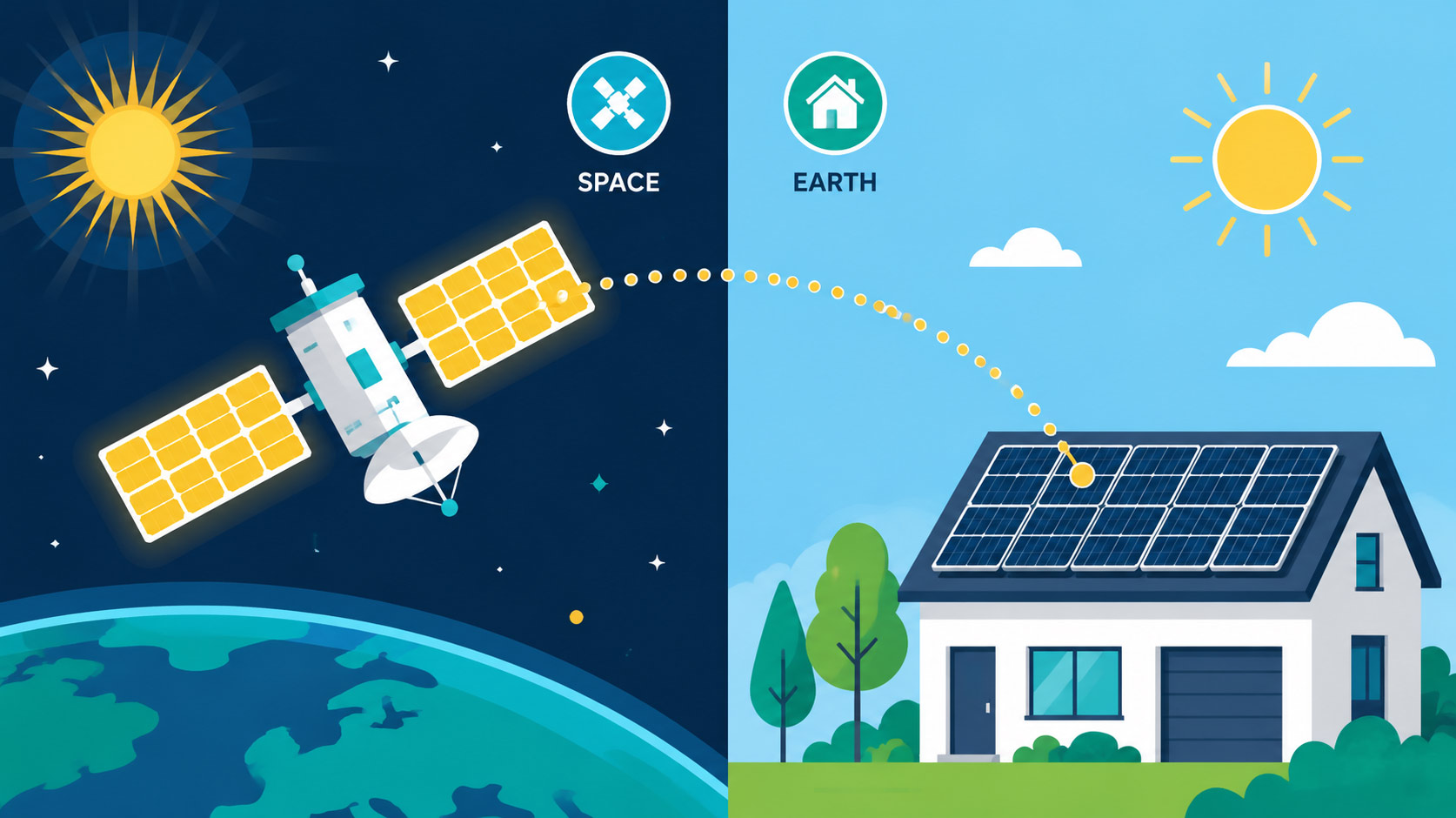
If a panel on a rooftop degrades, a crew can swap it out in an afternoon. A geostationary satellite orbits 36,000 kilometers above Earth: there is no roadside assistance up there. A small efficiency dip no one would notice on a rooftop can mean degraded communications on a satellite. In the worst case, a single panel failure can silence a spacecraft worth hundreds of millions of dollars.
The environment is unforgiving. With no atmosphere, ultraviolet light hits at full intensity — along with high-energy particles that slam through semiconductor materials, damaging them from the inside out. And because repair is simply not an option, every component must perform for the mission’s full lifetime, often measured in decades.
These demands make spacecraft solar arrays one of the most demanding applications of photovoltaic technology. Yet, starting from wildly different constraints, space and terrestrial PV have arrived at the same physical principles. Where they differ is in how they use those principles.
In orbit, protons and electrons tear through a cell’s crystal structure, creating damage deep inside the material — a problem known as bulk displacement. The fix? Make the active layer thinner so there’s less to hit, and add a cover glass that blocks the worst of it.
On Earth, there is no particle bombardment. But moisture, heat, and manufacturing imperfections create their own kind of defects — mostly at the cell’s surface, where they quietly steal current year after year. The fix here is passivation: ultra-thin coatings that seal those surface flaws shut. Modern n-type cells like TOPCon and heterojunction designs use atomic layer deposition (ALD) to apply these coatings at near-atomic precision.
Different damage, different defenses — but the same bottom line: every defect is one fewer electron reaching the circuit.
A single material can only convert part of sunlight into electricity. Space engineers solved this by stacking different semiconductor compounds, each capturing a different slice of the spectrum, pushing production-cell efficiency into the 30–34% range under the AM0 spectrum. These multi-junction cells are grown in precision reactors at costs that would make rooftop deployment prohibitively expensive.
Terrestrial PV had the same insight — stack absorbers, capture more light — but found a different route. Perovskite-on-silicon tandem cells have reached over 33% efficiency in the lab using solution-based processing that could eventually scale to rooftop economics. Same architectural idea. Radically different materials and cost structures.
In low Earth orbit, a satellite swings through sunlight and shadow roughly every 90 minutes, stressing every solder joint. Space missions handle this with bypass diodes and string-level redundancy — if one path fails, current finds another.
On the ground, modules face slower daily and seasonal cycles over 25 to 30 years. The terrestrial answer? Advanced interconnections — from multi-busbar to 20BB designs — that spread current across over a hundred contact points per module, so no single connection carries too much heat or stress.
Same physics — expansion and contraction fatigue electrical contacts. Different design priorities: space wants graceful degradation under rapid fire; terrestrial wants quiet, cool operation over decades.
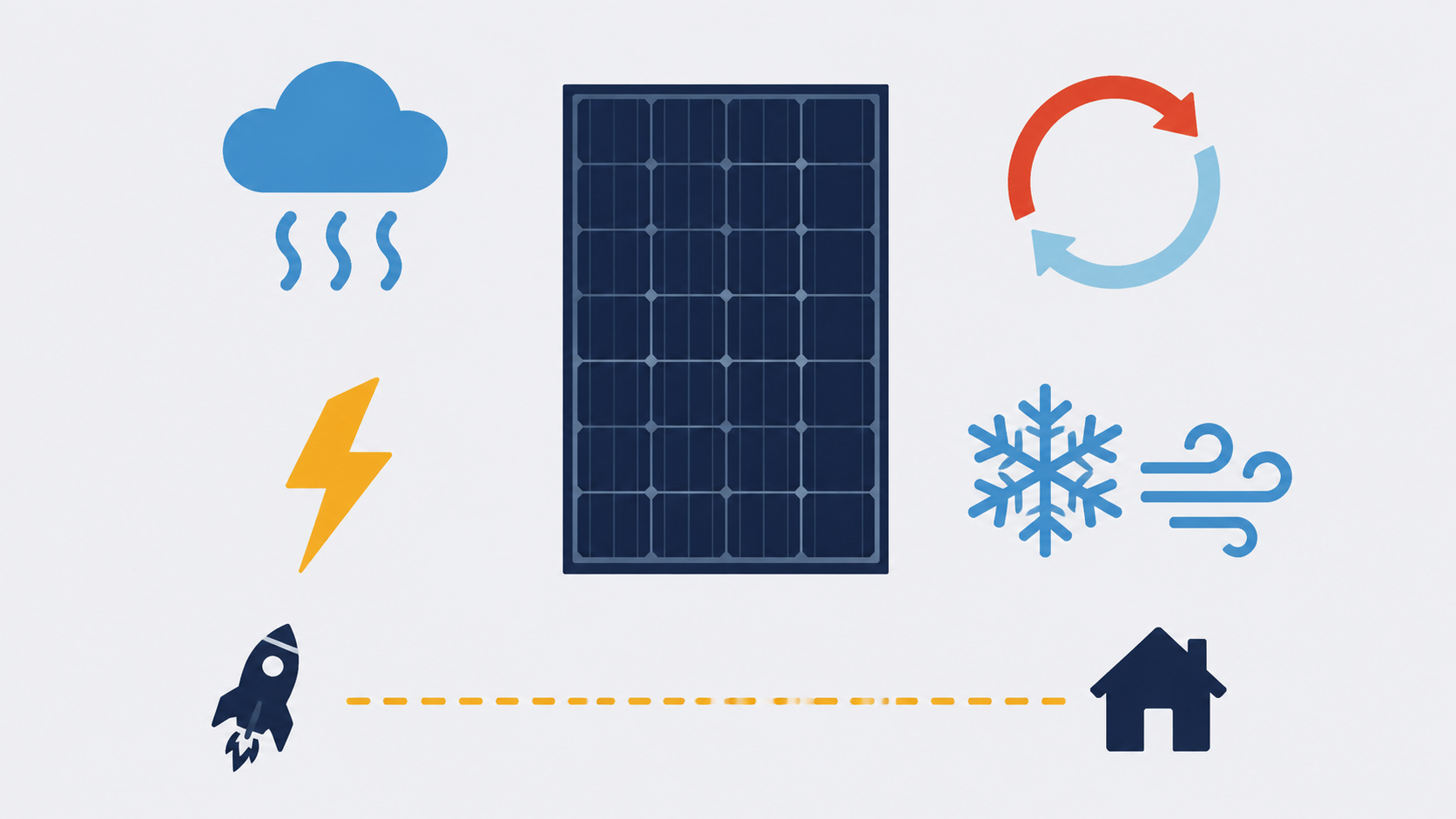
Whether a component flies to orbit or sits in a desert, reliability cannot be claimed — it must be demonstrated. Space programs shake arrays on vibration tables, bake them in vacuum chambers, and blast them with radiation to compress years of stress into weeks. The terrestrial industry uses its own gauntlet: the IEC 61215 standard requires 200 thermal cycles and 1,000 hours of damp heat. Real-world projects often demand double or triple those numbers. Both worlds, independently, arrived at the same conclusion: the most widely accepted proof of reliability is measured performance under accelerated stress.
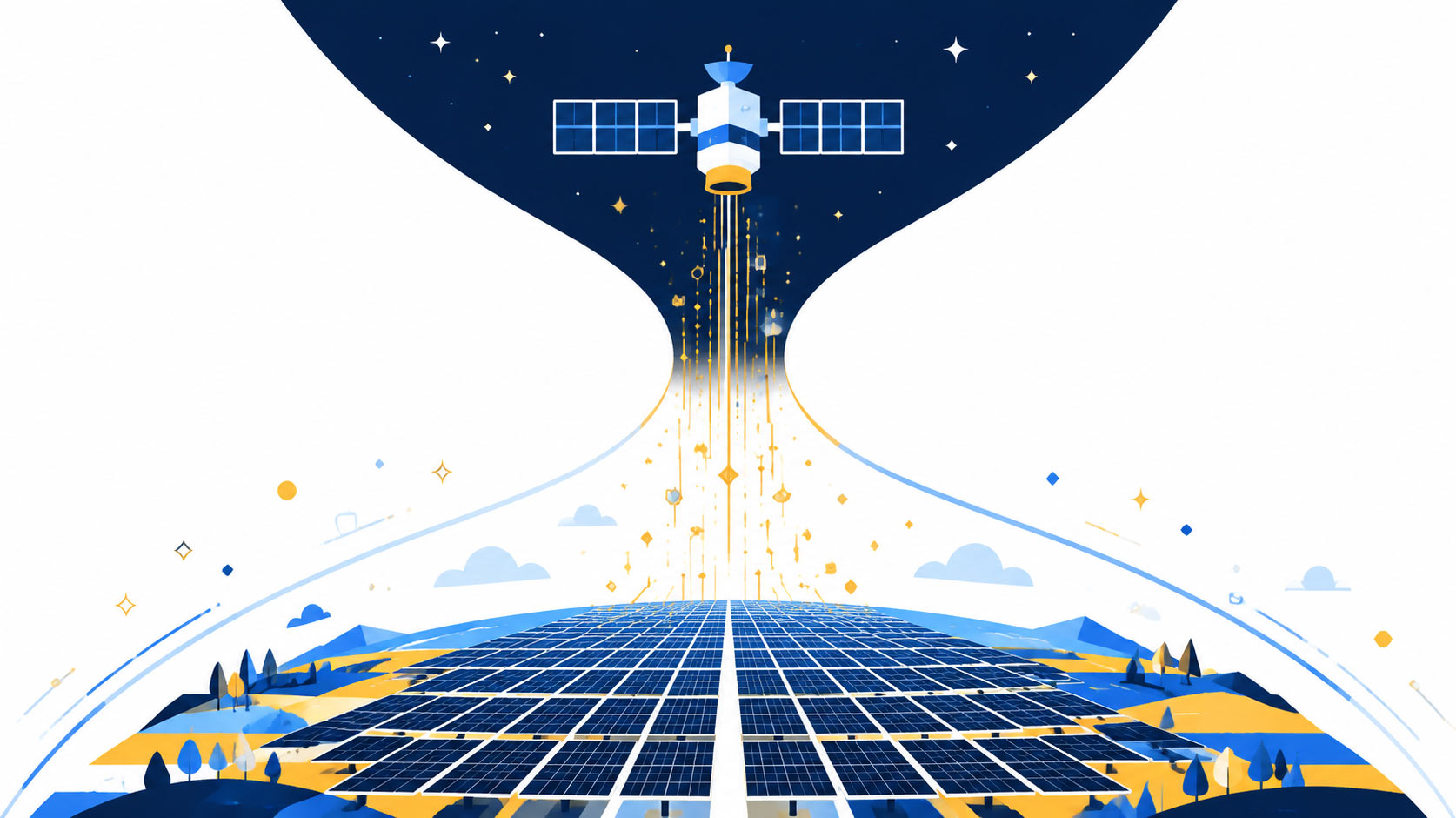
Space solar is a small fraction of the PV market by volume. Its value to terrestrial PV is not as a technology donor — the materials, manufacturing processes, and cost structures are too different — but as a parallel validation of core physical principles.
Both domains have confirmed, through independent paths, that suppressing defects matters, that capturing more of the spectrum unlocks efficiency, and that reliability must be proven through accelerated stress rather than assumed. The engineering answers diverge. The physics does not.
For Astronergy, this parallel validation reinforces a straightforward principle: photovoltaic technologies must deliver consistent performance under increasingly demanding conditions. By combining high efficiency, reliability-focused design, and deep manufacturing expertise, Astronergy continues to develop modules engineered for long-term energy generation — from high-irradiance deserts to humidity-laden coastlines.
 https://astronergy.com.au/wp-content/uploads/2026/09/The-Rise-of-Virtual-Power-Plants-How-Solar-and-Batteries-Can-Create-More-Value.jpg
941
1672
marketing.astro
/wp-content/uploads/2024/07/Astronergy-LOGO-black.png
marketing.astro2026-09-20 12:36:352026-09-23 18:53:43The Rise of Virtual Power Plants: How Solar and Batteries Can Create More Value
https://astronergy.com.au/wp-content/uploads/2026/09/The-Rise-of-Virtual-Power-Plants-How-Solar-and-Batteries-Can-Create-More-Value.jpg
941
1672
marketing.astro
/wp-content/uploads/2024/07/Astronergy-LOGO-black.png
marketing.astro2026-09-20 12:36:352026-09-23 18:53:43The Rise of Virtual Power Plants: How Solar and Batteries Can Create More Value https://astronergy.com.au/wp-content/uploads/2026/09/The-Digital-Solar-Farm-How-IoT-and-AI-Are-Optimizing-Large-Scale-Operations.jpg
768
1376
marketing.astro
/wp-content/uploads/2024/07/Astronergy-LOGO-black.png
marketing.astro2026-09-10 10:19:212026-09-23 18:53:44The Digital Solar Farm: How IoT and AI Are Optimizing Large-Scale Operations
https://astronergy.com.au/wp-content/uploads/2026/09/The-Digital-Solar-Farm-How-IoT-and-AI-Are-Optimizing-Large-Scale-Operations.jpg
768
1376
marketing.astro
/wp-content/uploads/2024/07/Astronergy-LOGO-black.png
marketing.astro2026-09-10 10:19:212026-09-23 18:53:44The Digital Solar Farm: How IoT and AI Are Optimizing Large-Scale Operations https://astronergy.com.au/wp-content/uploads/2026/09/Future-Proofing-a-Landmark-Hotel-A-Comprehensive-Energy-Upgrade-with-Solar.jpg
1152
2048
marketing.astro
/wp-content/uploads/2024/07/Astronergy-LOGO-black.png
marketing.astro2026-08-20 11:49:322026-09-03 17:23:48Future-Proofing a Landmark Hotel: A Comprehensive Energy Upgrade with Solar
https://astronergy.com.au/wp-content/uploads/2026/09/Future-Proofing-a-Landmark-Hotel-A-Comprehensive-Energy-Upgrade-with-Solar.jpg
1152
2048
marketing.astro
/wp-content/uploads/2024/07/Astronergy-LOGO-black.png
marketing.astro2026-08-20 11:49:322026-09-03 17:23:48Future-Proofing a Landmark Hotel: A Comprehensive Energy Upgrade with SolarAstronergy
News
Expos
Sustainability
Technology Innovation
Smart Manufacturing
Quality Control
Download Center
FAQs & Support
Solar Project Cases
After-sales Service
*By clicking subscribe, I agree to Astronergy’s Privacy Policy and Terms of Use.


 CHINT and Octopus Energy Sign Strategic Cooperation Agreements to Accelerate...
Scroll to top
CHINT and Octopus Energy Sign Strategic Cooperation Agreements to Accelerate...
Scroll to top